Friday, February 28, 2014

Libs bad for USA. Very Very Bad!!


Sent from my iPad

Monday, February 24, 2014

Agw

Cunningham's views on global warming are well known, and he has quite a bit to say on the matter. He is a physicist by education, was a founder of The Earth Awareness Foundation in 1970, has been on the board of the National Renewable Energy Laboratory for five years, and has been writing articles on the environment since 2000. He is an advocate against the theory of Anthropogenic Global Warming (AGW); in other words, he is a global warming skeptic.

"In our day it was something we felt was worth doing, to go out and push the frontier. Today is a risk-averse society, young people don't wanna take chances doing anything."

In September of this year, the Intergovernmental Panel on Climate Change (IPCC) released their latest report in which they state there is now a 95% probability that humans are responsible for global warming. UN Secretary-General Ban Ki-moon says the study is a call for governments to work to reach a planned UN accord in 2015 to combat global warming, while US Secretary of State John Kerry described it as "a wake-up call." IPCC chairperson Rajendra Pachauri claims the report is "of very high quality, totally credible and robust in every sense of the scientific content."

However, Cunningham does not agree, saying this latest report "is no more accurate than their earlier ones. This one is just a bit more toned down on its claims." He says the IPCC are still making "false claims that computer models 'prove' recent global warming is due to human CO2emissions, and that they are able to forecast future global temperatures, climates and events. In reality, the models greatly exaggerate climate sensitivity to carbon dioxide levels." Cunningham sums up his opinion by stating that he has "yet to see data supporting the claim that humans are responsible for controlling the world's temperature." He even argued his case in person at the 2013 United Nations Climate Change Conference, held in Warsaw in November. Although greatly outnumbered, said at a press briefing during the conference that "true believers in human-caused global warming cannot be reasoned out of their position, because it wasn't reason which got them there in the first place."


Sunday, February 23, 2014

Preeminence in space

HermanCain

Love your show. You tell it like it is. I really don't understand how the libs follow the " logic" they do. Anyway, I have tried to get hannity to speak in defense of preeminence in space & the space shuttle, but to no avail. Would like to get some on air discussion of the necessity for shuttle capabilities such as airlock, RMS, EVA capability, ability to place & retrieve large payloads, & conduct on orbit repair as we did with Hubble. It is a tragic situation that we have invested all the money & time in shuttle & just discard it. Please read " have we lost the will" by walt Cunningham re waltcunningham.com. If you could say a few words in support of USA preeminence in space, I would appreciate it. Keeptheshuttleflyingc.blogspot.com


WHY did we THROW Shuttle Away???

Look at the decisions being made in the various sectors of our economy, most nonsensical . After we were preeminent in space, our "leaders" placed our capability in museum. Walt Cunningham sums it up!

Cunningham 

The Space Shuttle program not only maintained our preeminence in space, it raised our technical expertise and further increased our prestige among the developed nations of the world—precisely the same reasons why the Chinese are now working toward landing a man on the Moon.

Congress is our last hope of putting a stop to the dismantling of a once great agency. They are concerned about job losses and the economic impact, but in the long run, they are not near as costly as the loss of an inspirational vision for the next generation of space scientists, engineers and explorers. You have only to look at Lewis and Clark, our westward expansion, Armstrong and Aldrin landing on the Moon to know exploration is in our blood. We should be proud of it. Americans need a frontier.

While NASA and some others are trying to put the best positive spin on the budget proposal, the negative fallout is building. Personnel requirements for the agency's new direction will do little to mitigate the tremendous losses from this foolish cancellation without a replacement in hand. The real loss, as in the 1970s, will be those trained and experienced engineers who are already leaving for more inspiring pursuits.


Sent from my iPad

Fwd: Space agency studying ways to capture derelict satellites, space junk


Sent from my iPad

Begin forwarded message:

From: "Gary Johnson" <gjohnson144@comcast.net>
Date: February 23, 2014 10:06:33 AM CST
To: "Gary Johnson" <gjohnson144@comcast.net>
Subject: FW: Space agency studying ways to capture derelict satellites, space junk


Inline image 1


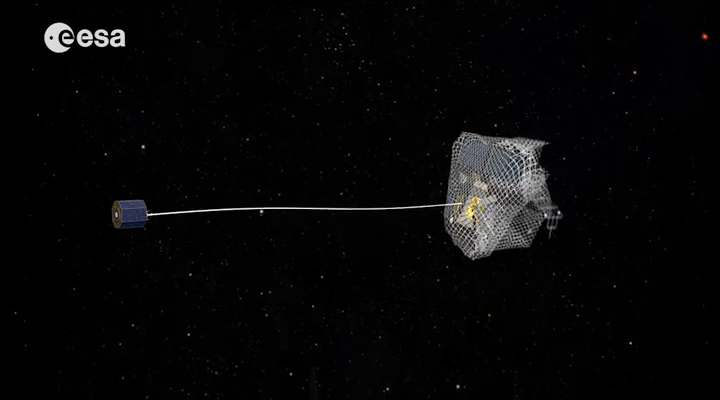
How to catch a satellite


Netting a derelict satellite

21 February 2014

Standard space dockings are difficult enough, but a future ESA mission plans to capture derelict satellites adrift in orbit. Part of an effort to control space debris, the shopping list of new technologies this ambitious mission requires is set for discussion with industry experts.

ESA's Clean Space initiative is studying the e.DeOrbit mission for removing debris, aiming to reduce the environmental impact of the space industry on Earth and space alike. 

Earth's debris halo

Decades of launches have left Earth surrounded by a halo of space junk: more than 17 000 trackable objects larger than a coffee cup, which threaten working missions with catastrophic collision. Even a 1 cm nut could hit with the force of a hand grenade.

The only way to control the debris population across key low orbits is to remove large items such as derelict satellites and launcher upper stages.

Such uncontrolled multi-tonne items are not only collision risks but also time bombs: they risk exploding due to leftover fuel or partially charged batteries heated up by orbital sunlight. 

The resulting debris clouds would make these vital orbits much more hazardous and expensive to use, and follow-on collisions may eventually trigger a chain reaction of break-ups.

Distribution of debris objects larger than 10 centimetres in space                                                                           

Distribution of space debris

Targeting key orbits

e.DeOrbit is designed to target debris items in well-trafficked polar orbits, between 800 km to 1000 km altitude. At around 1600 kg, e.DeOrbit will be launched on ESA's Vega rocket.

The first technical challenge the mission will face is to capture a massive, drifting object left in an uncertain state, which may well be tumbling rapidly. Sophisticated imaging sensors and advanced autonomous control will be essential, first to assess its condition and then approach it.

Making rendezvous and then steady stationkeeping with the target is hard enough but then comes the really difficult part: how to secure it safely ahead of steering the combined satellite and salvage craft down for a controlled burn-up in the atmosphere?

Several capture mechanisms are being studied in parallel to minimise mission risk. Throw-nets have the advantage of scalability – a large enough net can capture anything, no matter its size and attitude. Tentacles, a clamping mechanism that builds on current berthing and docking mechanisms, could allow the capture of launch adapter rings of various different satellites.

Harpoons work no matter the target's attitude and shape, and do not require close operations. Robotic arms are another option: results from the DLR German space agency's forthcoming DEOS orbital servicing mission will be studied with interest.


Grabbing a target

Strong drivers for the platform design are not only the large amount of propellant required, but also the possible rapid tumbling of the target – only so much spin can be absorbed without the catcher craft itself going out of control.

Apart from deorbit options based on flexible and rigid connections, techniques are being considered for raising targets to higher orbits, including tethers and  electric propulsion.

A symposium on 6 May in the Netherlands will cover studies and technology developments related to e.DeOrbit, with ESA and space industry representatives presenting their research and outlining their plans. For further information, or to register, go here


Copyright 2000 - 2014 © European Space Agency. All rights reserved.


===============================================================


Inline image 1

Space agency studying ways to capture derelict satellites, space junk

PARIS, Feb. 21 (UPI) -- The European Space Agency says it is studying the possibility of a future mission to capture derelict satellites adrift in orbit around the Earth.

The e.DeOrbit mission under study the ESA's Clean Space Initiative, would aim to snag and collect orbiting junk to reduce the environmental impact of the space industry on Earth and space alike, the agency said in a release issued from its Paris headquarters Friday.

Decades of launches have left Earth surrounded by a halo of space junk, with more than 17,000 trackable objects larger than a coffee cup that could threaten working missions with catastrophic collision, ESA scientists said.

The only way to control the debris field across key low orbits is to remove large items such as derelict satellites and launcher upper stages, they said.

The first technical challenge such a mission would face is to safely approach a drifting object left in an uncertain state; then capture it and guide the combined satellite and salvage craft down for a controlled burn-up in the atmosphere.

Several capture mechanisms are being studied, the ESA said, including throw-nets, clamping mechanisms and harpoons.

A symposium in the Netherlands in May will cover studies and technology developments related to e.DeOrbit, the ESA said.


© 2014 United Press International, Inc. All Rights Reserved. 


===============================================================


Inline image 1


How We Will Retrieve Dead Satellites In The Future? Hint: It Likely Won't Be Using Astronauts

by Elizabeth Howell on February 21, 2014

NASA astronaut Dale Gardner captures the malfunctioning WESTAR-VI satellite in 1984. Gardner was using the Manned Maneuvering Unit, a sort of space backpack that was discontinued for astronaut use after the Challenger explosion of 1986. Credit: NASA

NASA astronaut Dale Gardner captures the malfunctioning WESTAR-VI satellite in 1984. Gardner was using the Manned Maneuvering Unit, a sort of space backpack that was discontinued for astronaut use after the Challenger explosion of 1986. Credit: NASA

I'll admit it: I'm too young to remember 1984. I wish I did, however, because it was a banner year for the Manned Maneuvering Unit. NASA astronaut Dale Gardner, for example, used this jet backpack to retrieve malfunctioning satellites, as you can see above. (FYI, Gardner died Wednesday (Feb. 19) of a brain aneurysm at the age of 65.)

After three shuttle flights, however, NASA discontinued use of the backpack in space for several reasons — most famously, safety considerations following the shuttle Challenger explosion of 1986. But thirty years on, the problem of dead satellites is growing. There are now thousands of pieces whipping around our planet, occasionally causing collisions and generally causing headaches for people wanting to launch stuff into orbit safely.

Space agencies such as NASA and the European Space Agency have been working hard on reducing debris during launches, but there's still stuff from decades before. And when a satellite goes dead, if it's in the wrong orbit it could be circling up there for decades before burning up. How do you fix that?

Robotics has come a long way in 30 years, so space agencies are looking to use those instead to pick up derelict satellites since that would pose far less danger to astronauts. One example is the e.DeOrbit mission recently talked about by ESA, which would pick up debris in polar orbits of altitudes between 800 and 1,000 kilometers (about 500 to 620 miles).

One design idea for the e.DeOrbit mission, which would retrieve dead satellites from orbit. Credit: European Space Agency

One design idea for the e.DeOrbit mission, which would retrieve dead satellites from orbit. Credit: European Space Agency

The mission would use autonomous control and image sensors to get up close to the drifting satellite, and then capture it in some way. Several ideas are being considered, ESA added. A big enough net could easily nab the satellite, or perhaps one could clamp on using tentacles or grab it with a harpoon or robotic arm. Here's a 2013 proposal with more information on e.DeOrbit. ESA noted there is a symposium coming up May 6 to discuss this in more detail.

e.DeOrbit is one of just several proposals to pick satellites up. A Swiss idea called CleanSpace One appears to use a sort of pincer claw to grab satellites for retrieval. The Phoenix program (proposed by Defense Advanced Research Projects Agency) would take useable parts off of broken satellites for use in new satellites, and in past years DARPA had some ideas to remove satellites from orbit as well. Another option is satellite refueling to make these machines useable again, a possibility that NASA, Canada and many others are taking seriously.


===============================================================

Makes environmental sense- hahaha

Interesting that the LA times did this.. Lou Dobbs reported this on CNN and it cost him his job. The only network we would see this on would be FOX.. All the others are staying away from it.Whether you are a Democrat or Republican this should be of great interest to you!
Just One State -be sure and read the last part..
This is only one State.................If this doesn't open eyes, nothing will!

From the L. A. Times
1..40%of all workers in L. A. County ( L. A. County has 10.2 million people) are working for cash and not paying taxes. This is because they are predominantly illegal immigrants working without a green card.
2.. 95%of warrants for murder in Los Angeles are for illegal aliens.
3.. 75%of people on the most wanted list in Los Angeles are illegal aliens.
4.. Over2/3of all births in Los Angeles County are to illegal alien Mexicans on Medi-Cal, whose births were paid for by taxpayers.
5..Nearly 35% of all inmates in California detention centers are Mexican nationals here illegally.
6..Over 300,000 illegal aliensin Los Angeles County are living in garages.
7.... The FBI reportshalfof all gang members in Los Angeles are most likely illegal aliens from south of the border.
8Nearly 60%of all occupants of HUD properties are illegal.
9.. 21 radio stations in L. A. are Spanish speaking.
10. In L.. A. County 5.1 million people speak English, 3.9 million speak Spanish.. (There are 10.2 million people in L. A. County .......)
(All 10 of the above facts were published in the Los Angeles Times)
Less than 2% of illegal aliens are picking our crops, but29% are on welfare. Over 70% of the United States ' annual population growth(and over 90% of California , Florida , and New York ) results from immigration.29% of inmates in federal prisons are illegal aliens.
We are fools for letting this continue .....
HOW CAN YOU HELP ?
Send copies of this letter to at least two other people. 100 would be even better.

Sent from my iPad